
So, you’ve got $1,000 burning a hole in your pocket. Not burning for a new gadget or a fancy dinner, but burning with purpose. You're thinking, “It's time to make this money work for me.” Maybe you've heard stories of people turning small sums into big fortunes, or maybe you're just tired of watching inflation eat away at your savings.
Whatever your motivation, you’re at a crucial crossroads.
For many, that first $1,000 feels like both a blessing and a curse. It's enough to feel significant, but not so much that you automatically know what to do with it. But where do you even begin? You scroll through endless articles, hear conflicting advice from friends, and get lost in a sea of jargon: stocks, bonds, ETFs, crypto, mutual funds, 401(k)s, IRAs…
That feeling of being frozen by too many choices is a common roadblock. The fear of making the wrong move often leads to the worst move of all: inaction.
But here’s the good news: having $1,000 to invest in 2026 isn't a limitation; it’s an incredible starting point. The financial world has democratized investing like never before, offering powerful tools that were once only available to the ultra-rich.
This isn't a “get rich quick” scheme. This is a “get smart now, get rich slowly and surely” guide. By the end of this post, you won't just know what to do with your $1,000; you'll understand why you're doing it, setting a foundation for long-term financial success.
Let's break down exactly how you can turn that initial $1,000 into the seed of a flourishing financial future.
Before You Invest: The Non-Negotiable Foundation
Hold on a second! Before we even talk about where to put that $1,000, we need to address two critical questions. Skipping these steps is like building a skyscraper on quicksand – it looks good until it all comes crashing down.
1. Do You Have an Emergency Fund?
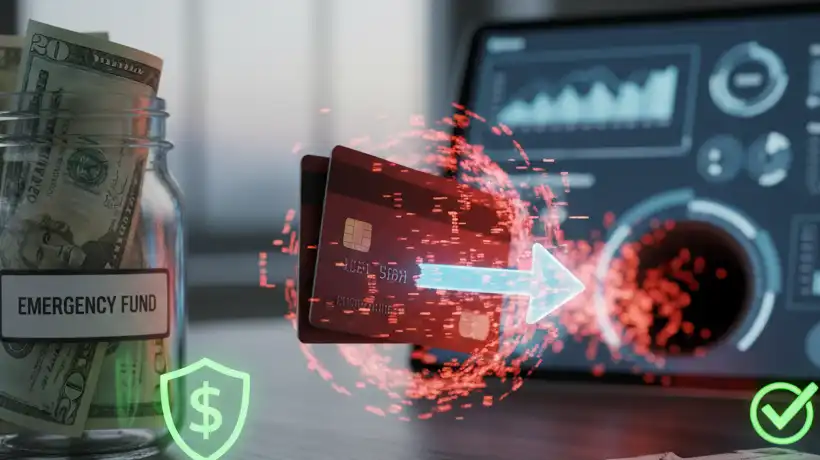
This is non-negotiable. An emergency fund is 3-6 months' worth of living expenses stashed away in an easily accessible, high-yield savings account (HYSA). It's your financial bodyguard, protecting you from unexpected job loss, medical emergencies, or car repairs.
Investing without this safety net is like walking a tightrope with no net. Life will inevitably throw a curveball, and when it does, the last thing you want is to be forced to sell your investments at the worst possible time—likely at a loss—just to cover an unexpected bill. This can undo all your hard work in an instant.
That’s why it’s crucial to be brutally honest with yourself. If your $1,000 is your emergency fund, then congratulations! You’ve already made your first smart financial move. Your best course of action is to keep it in a HYSA and focus on building it up to that 3-6 month mark before you start investing. This might not be the exciting answer, but it's the responsible one. Your future self will thank you.
2. Are You Carrying High-Interest Debt?
Credit card debt, payday loans, high-interest personal loans – these are financial vampires sucking the life out of your money. The interest rates (often 15-25% or more) virtually guarantee that any returns you make on an investment will be instantly negated by what you’re paying in interest.
Think of high-interest debt as a massive anchor dragging your financial ship. Trying to sail forward by investing while that anchor is down is an exercise in futility. You're losing money faster than you can make it.
For this reason, if your $1,000 can significantly pay down or eliminate high-interest debt, that is your best “investment.” Consider it a guaranteed return equal to your interest rate. Imagine eliminating a 20% interest rate – that’s a 20% “return” on your money, something incredibly difficult to achieve consistently in the stock market. Tackle credit card debt, then return here.
If you've got an emergency fund and your high-interest debt is under control, then read on. Your $1,000 is ready for action!

Step 1: Maximize Your Employer Benefits (If Applicable)
This is often the easiest and most powerful first step, especially for beginners.
The 401(k) Match: If your employer offers a 401(k) or similar retirement plan and provides a matching contribution (e.g., they'll contribute 50 cents for every dollar you put in, up to 6% of your salary), this is literally free money.
It’s astonishing how many people overlook their employer match or don't realize just how much free money they're leaving on the table each year. It's a part of your compensation package, and not taking it is like turning down a raise.
Even if your $1,000 doesn't cover your entire match for the year, your priority should be to direct as much of it as possible (or set up regular contributions from your paycheck) to capture that match. If your employer matches dollar-for-dollar up to 3% of your salary, and you make $50,000, that’s $1,500 of free money annually. Missing that is a huge mistake! Your $1,000 can kickstart this, or if you can comfortably afford it, use it to boost your contributions for a month or two to meet that match sooner.
Step 2: Open a Roth IRA: Your Retirement Superpower
If you don't have an employer match, or after you've maximized it, your next stop should be a Roth IRA. This is arguably one of the best investment vehicles for most people, especially those just starting out.
What is a Roth IRA? It's a retirement account where you contribute after-tax money, and then all your investments grow tax-free, and qualified withdrawals in retirement are also tax-free. Think about that: decades of tax-free growth!
For many, retirement planning feels distant, complicated, and overwhelming. This can lead to delaying the process, which unfortunately means missing out on the most powerful force in finance: compound growth over many years.
A Roth IRA is the perfect antidote to this procrastination. It's simple to set up, and its benefits are enormous:
-
Tax-Free Growth & Withdrawals: This is the biggest perk. Your future self will thank you for not having to pay taxes on your investment gains in retirement.
-
Flexibility: You can withdraw your contributions (not earnings) at any time, for any reason, tax- and penalty-free. This offers a great safety net, although it's best to avoid it if possible.
-
Control: Unlike a 401(k), you pick your own investments within the Roth IRA.
-
Low Minimums: Many brokers allow you to open a Roth IRA with $0 and invest with very small amounts. Your $1,000 is more than enough to get started.
Starting a Roth IRA with $1,000 is a powerful act of self-care for your future. Even small contributions made consistently for decades can grow into hundreds of thousands of dollars. To get started, choose a reputable, beginner-friendly brokerage like Fidelity, Vanguard, or Charles Schwab, open your Roth IRA account online, and transfer your $1,000. Now, for the most important part: don't just leave it as cash. We need to put it to work.

Step 3: Invest Your $1,000 in a Diversified, Low-Cost Index Fund or ETF
Okay, your $1,000 is in your shiny new Roth IRA. Now, what do you actually buy? This is where many beginners freeze up. The pressure to pick the next Amazon or Tesla, combined with the fear of choosing the “wrong” stock, can be paralyzing.
Fortunately, there’s a simple, powerful, and time-tested strategy that eliminates this guesswork: invest in broad market index funds or ETFs.
What are Index Funds/ETFs? An index fund (or Exchange Traded Fund – ETF) is a type of mutual fund that holds a diversified basket of stocks designed to mimic the performance of a specific market index. The most popular is an S&P 500 index fund, which holds stocks of the 500 largest U.S. companies.
Why are they perfect for your $1,000 (and beyond)?
-
Instant Diversification: With one purchase, you’re investing in hundreds of companies across various sectors. This significantly reduces your risk compared to buying individual stocks. If one company struggles, the other 499 can pick up the slack.
-
Low Cost (Low Expense Ratios): These funds are passively managed, meaning they don't have a team of highly paid analysts constantly trying to beat the market. This translates to incredibly low fees (called “expense ratios”), often less than 0.10% per year.
-
Market Returns: Over the long term, the S&P 500 has historically returned about 10-12% annually. While past performance doesn't guarantee future results, investing in the broad market means you get to participate in the overall growth of the economy without having to be a stock-picking wizard.
-
Simplicity: You buy it, you hold it, and you add to it consistently. You don't need to spend hours researching companies or watching stock tickers.
Specific Recommendations for Your First $1,000:
-
Vanguard S&P 500 ETF (VOO): Tracks the S&P 500. Very low expense ratio.
-
iShares Core S&P 500 ETF (IVV): Also tracks the S&P 500.
-
Fidelity 500 Index Fund (FXAIX): Fidelity's equivalent S&P 500 index fund.
Most brokers allow you to buy fractional shares of ETFs, meaning your entire $1,000 can be invested. Once your money is in your Roth IRA, search for one of these funds on your brokerage platform and invest the full amount. Congratulations, you are now a part-owner of the 500 biggest companies in America!
Step 4: Automate Your Future Contributions (The Real Secret Sauce)
Investing that first $1,000 is a fantastic start, but it's just that—a start. The true power of wealth building comes from consistency and compound interest.
The reality is, life gets in the way. After the initial excitement of investing, the discipline of remembering to make regular contributions often falls by the wayside, which can dramatically slow down your wealth accumulation.
The best way to combat this is to take your willpower out of the equation entirely. Automate your contributions.
Set up an automatic transfer from your checking account to your Roth IRA (or 401(k)) for a set amount each month. Even $50 or $100 a month makes a huge difference over time. Treat this automated transfer like another bill you have to pay—it's paying your future self. As your income grows, aim to gradually increase your monthly contribution amount.
The Power of Automation + Compound Interest: Let's say you invest your initial $1,000 and then contribute just $100 per month. Assuming an average annual return of 7% (conservative for the market over the long term):
-
After 10 years: You’ll have contributed $13,000, but your money could be worth over $19,000.
-
After 20 years: You’ll have contributed $25,000, but your money could be worth over $52,000.
-
After 30 years: You’ll have contributed $37,000, but your money could be worth over $120,000!
And that's with just $100 a month! This is how ordinary people become financially independent.

Step 5: Resist the Urge to Tinker (Long-Term Mindset)
Once your money is invested in a broad market index fund, your primary job is to do almost nothing.
It’s human nature to want to react. Seeing market fluctuations or hearing a friend brag about the “next big stock” can create a potent cocktail of anxiety and FOMO (Fear Of Missing Out). This often leads to impulsive buying and selling at the worst times, which is a primary reason why many individual investors underperform the market.
To succeed, you must adopt a long-term mindset. Investing is not a sprint; it's a decades-long marathon.
-
Market Dips are Opportunities: When the market goes down, it feels scary. But for a long-term investor, it means you're buying shares “on sale.” Don't panic sell.
-
Ignore the Noise: The financial news is designed to keep you glued, not necessarily to make you rich. Tune out the daily headlines and focus on your long-term plan.
Your $1,000, invested wisely and consistently, has the potential to grow into a significant sum. The key is patience and discipline.
Your $1,000: A Catalyst for Change
Having $1,000 to invest in 2026 isn't just about the money itself. It's about taking control, breaking free from financial anxiety, and building a habit that will serve you for the rest of your life. It's about making a statement to yourself that you are serious about your financial future.
This isn't just about putting money into a market; it's about investing in your peace of mind, your freedom, and your ability to live the life you truly want. Don't let fear or overwhelm stop you. Take that first step. Open that account. Make that transfer.
Your future self is waiting to thank you.


